On the optimal integration of intelligent agents into network systems to steer cooperation
Abstract
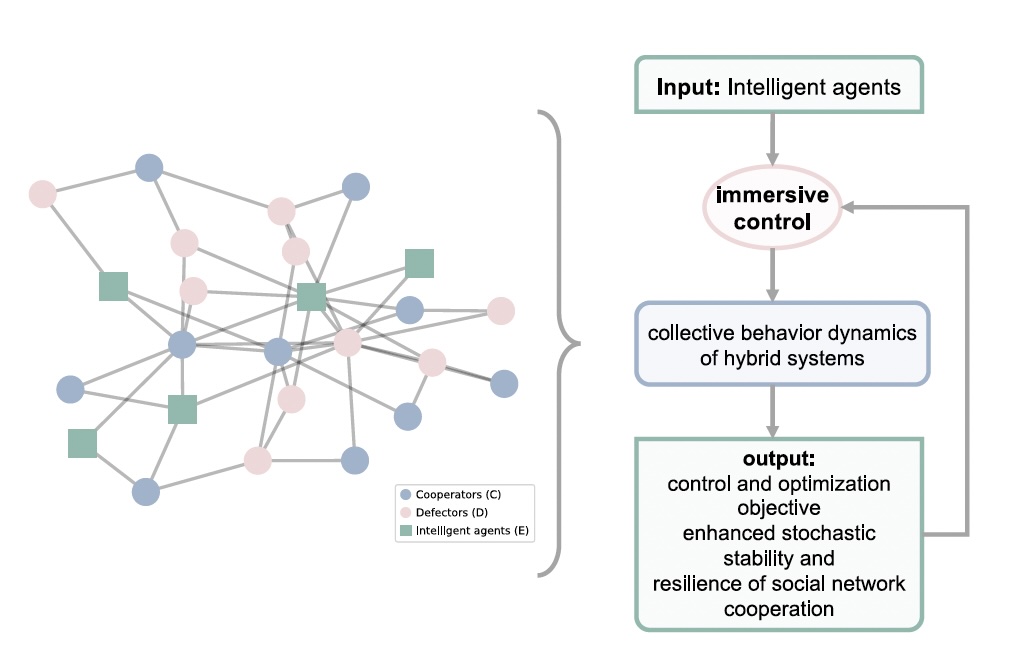
Sociotechnical networks, in which humans and technologies act as interacting entities (also known as "hybrid systems"), increasingly face perturbations by automated agents. What this implies for immersive steering of collective behavior, and how this shapes the stability and resilience of cooperation, remain unclear. Here, we extend evolutionary graph theory by incorporating a distinct type of node representing embedded intelligent agents, namely, algorithmic nodes that autonomously implement prescribed behavioral responses during interactions. These agents are randomly placed within a social network and exert local influence in their neighborhood in social dilemma games. Individual behavior changes are driven by evolutionary dynamics. We derive closed-form analytical results characterizing evolutionary stability and long-run cooperation levels, and show that there exists an optimal, intermediate prevalence of intelligent agents that best promotes cooperation. Our work offers insights into the optimal alignment of human populations with respect to the social good using intelligent agents.
Citation:
Fu F, Chen X, Christakis NA. On the optimal integration of intelligent agents into network systems to steer cooperation. Proc Natl Acad Sci U S A. 2026 Mar 24;123(12):e2537939123. doi: 10.1073/pnas.2537939123. Epub 2026 Mar 16. PMID: 41838917.