Social Networks and International Migration in Honduran Villages
Abstract
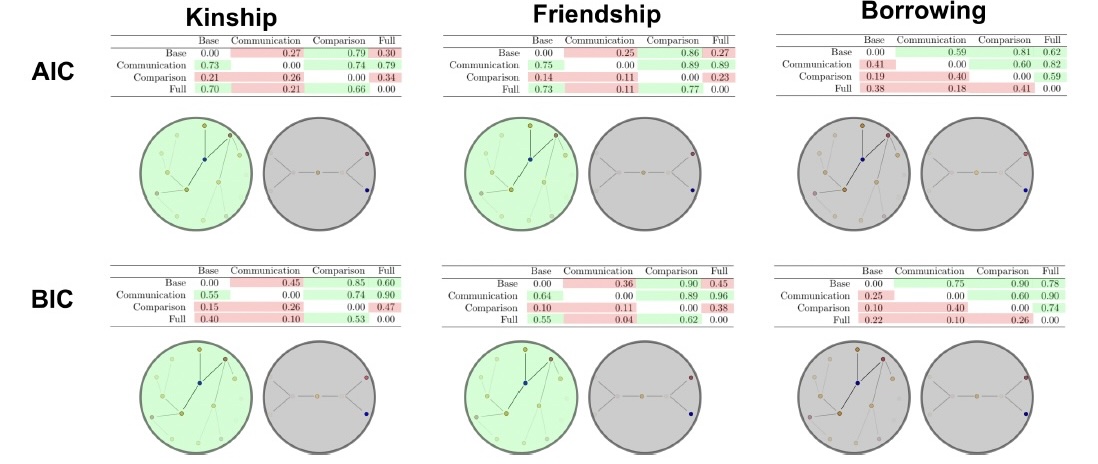
Social relationships are central to shaping international migration patterns, yet the link between widescale network structure and mobility decisions remains poorly understood. Here, we investigate two key mechanisms by which social networks influence migration behavior: transmission of information and resources, and com-parison of social status. These mechanisms suggest distinct sets of alters that an ego may emulate with respect to their migration behaviors, resulting in divergent mobility trajectories within and across communities. Leveraging longitudinal data from 73 Honduran villages (N = 15,480 individuals) over six years, we use a Linear Network Autocorrelation Modeling framework to disentangle the effects of kinship, friendship, and economic ties on international migration decisions. Our findings reveal that incorporating social network factors as predictors significantly improves model fit. While indicators for resource-sharing processes substantially contribute to model performance, the inclusion of structural comparison mechanisms does not provide additional explanatory power. These results underscore the critical role of information and resource transmission within social networks in facilitating migration behaviors.
Citation:
Thomas LJ, Christakis NA, Garip F. Social networks and international migration in Honduran villages. Proc Natl Acad Sci U S A. 2026 Jan 6;123(1):e2505818122. doi: 10.1073/pnas.2505818122. Epub 2026 Jan 2. PMID: 41481447; PMCID: PMC12773785.