Countering the Forgetting of Novel Health Information with ‘Social Boosting’
Abstract
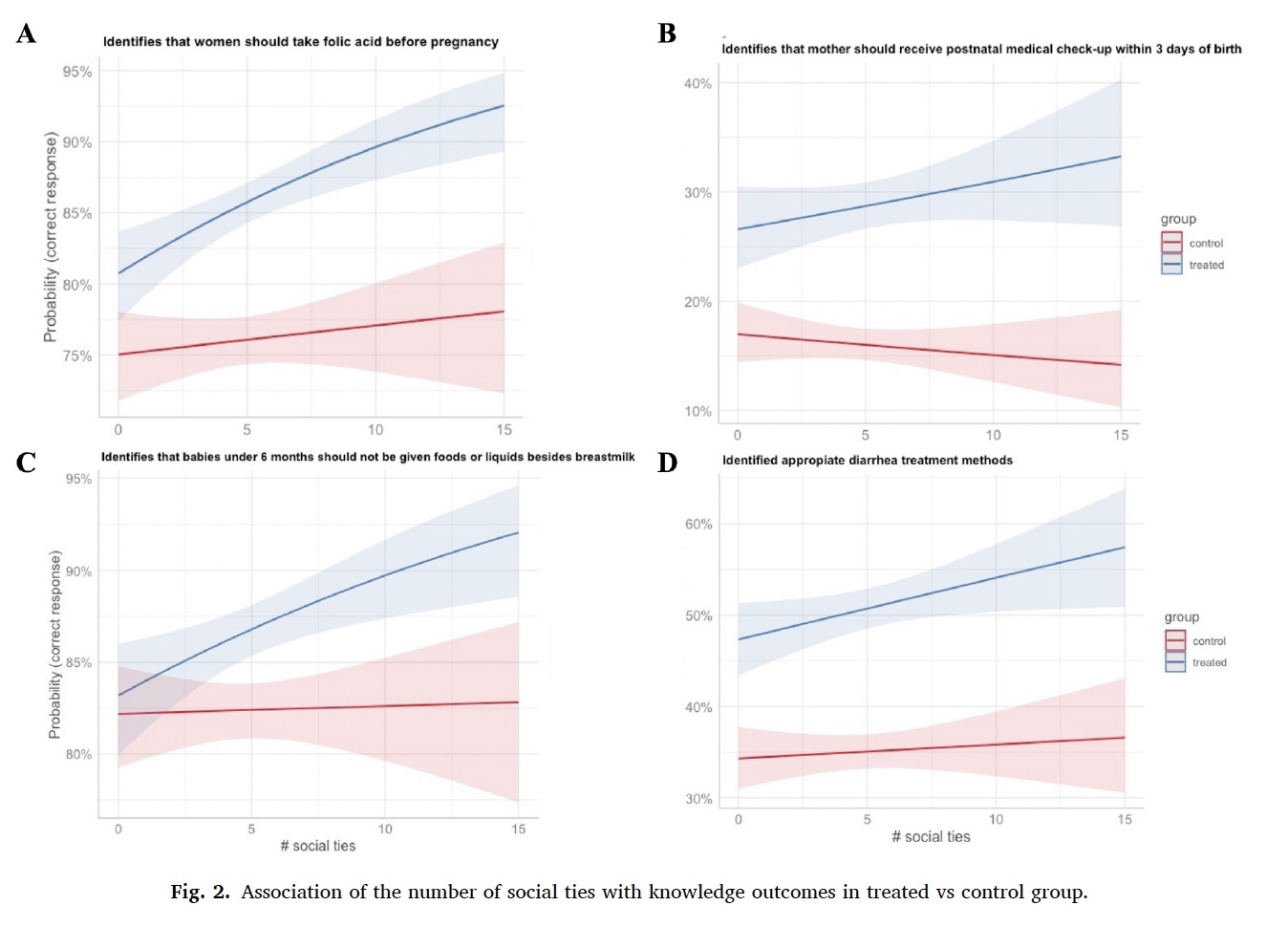
The prevalence of misleading information, especially with respect to health care practices, poses a threat. While studies have shown the effectiveness of various intervention techniques in mitigating the adverse effects of low-quality or false information, the effectiveness of such interventions can decay. Here, we investigate the role of the detailed social structure within which the intervened individuals live, which provides opportunities for the individuals to discuss and internalize new knowledge. We evaluated this with respect to information about maternal and child health care, delivered via a 22-month in-home intervention, among targeted individuals in 110 isolated Honduran villages. We hypothesize that individuals who receive specific knowledge can internalize and consolidate this information by engaging in social interactions where, for instance, they have an opportunity to discuss it with others. We found that well-connected individuals within a social network experience an enhanced effectiveness of knowledge interventions. These individuals may be more likely to internalize and retain the information and reinforce it in others, due to increased opportunities for social interaction where they teach or explain new knowledge, a mechanism we refer to as "social boosting". These findings underscore the role of social interactions in reinforcing health knowledge interventions.
Citation:
Krishna V, Christakis NA. Countering the forgetting of novel health information with ‘social boosting.' SSM Popul Health, 33 (2026); 101902